
In the Machine-to-Machine (M2M) and Industrial IoT (IIoT) industries, reliability isn’t just a performance metric—it is a regulatory requirement.M2M hardware, such as protocol converters, cellular routers, and managed switches, must operate autonomously in environments saturated with electromagnetic noise.
If a device emits too much interference, or if it is overly sensitive to ambient electrical fields, entire automated assembly lines can grind to a halt.To guarantee hardware coexistence and system safety, global regulatory bodies enforce strict compliance standards.
For network engineers and product procurement managers, understanding these essential standards and certifications is critical to picking the right equipment.
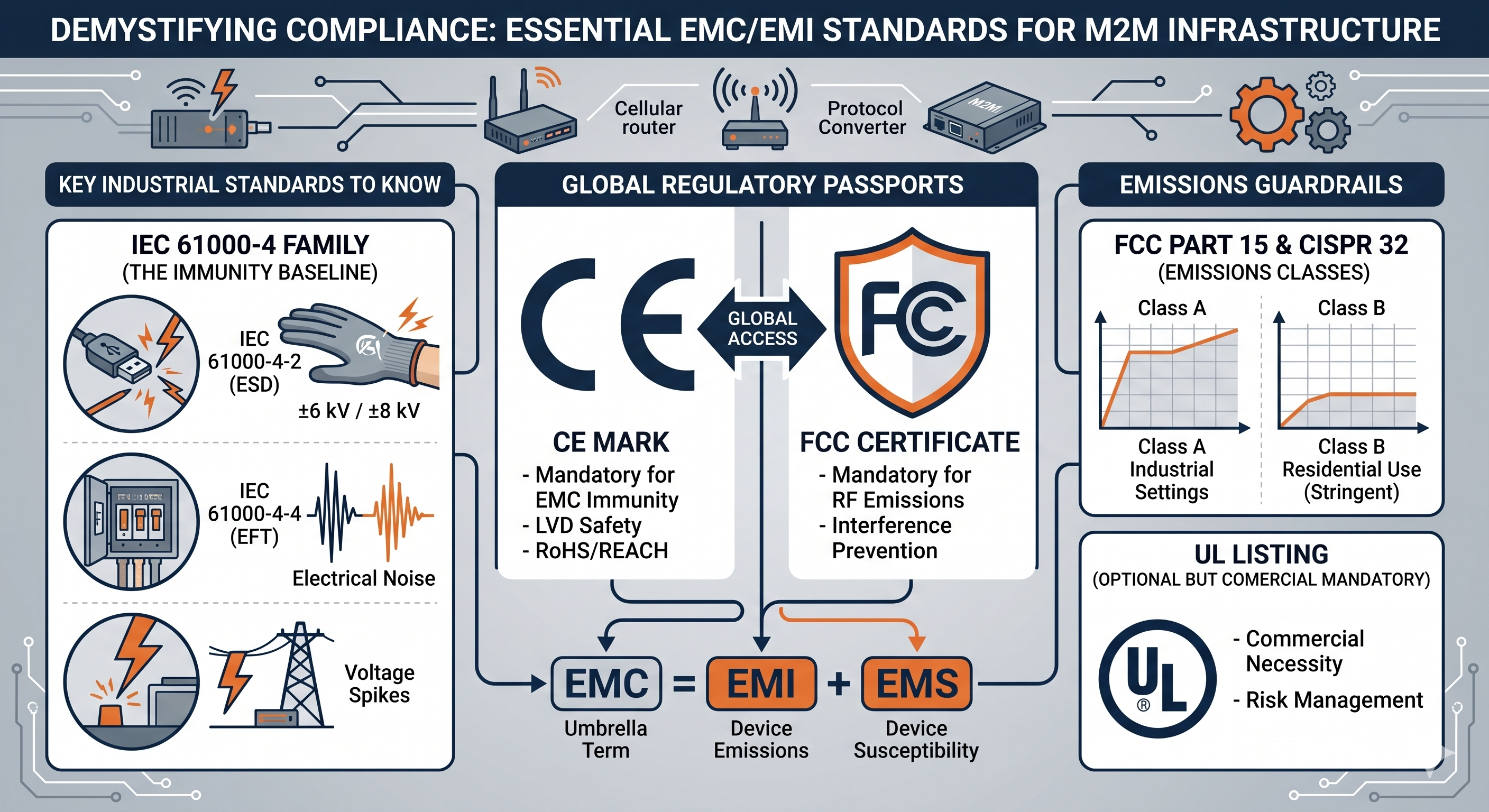
Decoding the Alphabet Soup: EMC, EMI, and EMS
Before diving into specific certifications, it is vital to understand the structural relationship between these core industrial concepts:
- EMC (Electromagnetic Compatibility): The umbrella term describing a device’s ability to operate properly in its intended environment without disrupting neighboring systems.EMC is split into two halves: EMI and EMS.
- EMI (Electromagnetic Interference / Emissions): This measures the electromagnetic pollution a device produces. Hardware must limit its unintended emissions so it doesn’t corrupt local radio transmissions or baseline power lines.
- EMS (Electromagnetic Susceptibility / Immunity): This measures a device’s ability to tolerate incoming electrical stress.High industrial immunity ensures a switch won’t crash when nearby heavy motors start up or create sudden power surges.
EMC = EMI + EMS
A compliant M2M device must minimize its own output (EMI) while maximizing its defensive resilience (EMS).
Crucial Industrial Standards to Know
When assessing an M2M product datasheet, look beyond basic “consumer” testing. Industrial environments demand compliance with specialized, rigorous benchmark testing.
The IEC 61000-4 Family (The Immunity Baseline)
The International Electrotechnical Commission (IEC) establishes specific lab testing procedures to evaluate structural hardware immunity. Key tests to check for include:
- IEC 61000-4-2 (ESD): Evaluates tolerance against Electrostatic Discharge (e.g., when a technician touches a port in a dry environment). Industrial grade usually requires ±6 kV contact and ±8 kV air discharge tolerance.
- IEC 61000-4-4 (EFT): Tests resistance to Electrical Fast Transients/Bursts, simulating high-frequency electrical noise caused by circuit breakers or switching inductive loads.
- IEC 61000-4-5 (Surge): Evaluates protection against high-energy voltage spikes caused by lightning strikes or massive switching transients.
FCC Part 15 & CISPR 32 (The Emissions Guardrails)
For emissions control, the U.S. Federal Communications Commission (FCC) and the International Special Committee on Radio Interference (CISPR) divide operating limits into two regulatory classes:
- Class A: Explicitly certified for commercial, industrial, or business settings. These devices are allowed slightly higher emission tolerances due to the typical baseline layout of an industrial facility.
- Class B: Intended for residential use, carrying far more stringent emission ceilings to safeguard home appliances.
Essential Global Passports: Mandatory Regional Marks
To legally import and deploy M2M products, hardware must display mandatory regional stamps proving complete testing verification.
CE Marking (European Economic Area)
The CE Mark acts as a regulatory passport for entry into European markets. For industrial automation hardware, a CE self-declaration means the unit complies with several unified directives:
- EMC Directive (2014/30/EU): Dictates both acceptable emission limits and essential immunity thresholds.
- Low Voltage Directive (LVD): Assures essential user electrical safety parameters.
- RoHS/REACH: Restricts hazardous material use (such as lead or mercury) within electronic manufacturing components.
FCC Certification (United States)
Enforced strictly by the U.S. government, FCC certification ensures that a device’s intentional or unintentional radio frequency output won’t cause harmful interference with emergency services or communication infrastructure. If a device oscillates above 9 kHz, an FCC label is required.
Unlike CE, which evaluates both emission and immunity protection, the FCC mark strictly concentrates on measuring outgoing RF emissions.
UL Listing (Underwriters Laboratories)
While UL certification is technically optional by federal law, it is often commercially mandatory for industrial procurement. Major enterprises and brick-and-mortar installations demand UL safety listings to manage risk, verify basic thermal performance, and satisfy corporate safety protocols.
Summary Checklist for Buyers
When selecting your next industrial protocol gateway or switch, cross-verify the datasheet against this standard checklist:
- Environment Match: Does the device carry FCC Class A / CISPR 32 Class A emissions filtering specifically rated for industrial settings?
- Immunity Validation: Does it explicitly state compliance with basic structural tests like IEC 61000-4-2/4/5?
- Regional Access: Does the unit carry both the CE and FCC marks to allow legally compliant deployment across global territories?
By keeping these foundational standards in mind, you can protect your operation from expensive communication dropouts and ensure your hardware coexists safely with existing site systems.
For a deeper dive into how global product compliance works for complex electronics and industrial infrastructure, you can watch this informative Product Compliance Guide. This video explains how compliance criteria intersect with long-term system reliability for critical field devices.